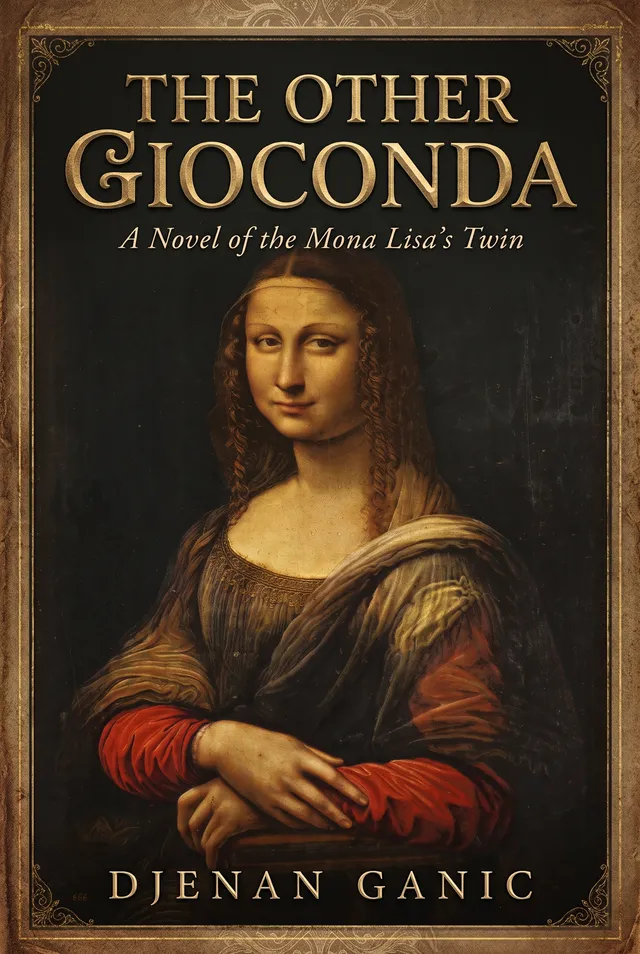
Cover of The Other Gioconda
← All books

Coming soon

The Other Gioconda

A Novel of the Mona Lisa's Twin

A novel about the people history forgets — and the painting that remembered them.

Setting
Florence, 1503 · Madrid, 2011
Era
Renaissance Italy & modern Madrid
Genre
Historical fiction

The story

What it’s about

Florence, 1503. Benedetto, a baker’s son from the poor side of the river, is fourteen when Leonardo da Vinci takes him into his workshop. Within months he is sitting at a second easel beside the master, painting the same young merchant’s wife, stroke for stroke, as Leonardo paints her. Her name is Lisa del Giocondo. Over the years that follow, the boy comes to see her more clearly than anyone around her. He also sees the cage she lives in, and he hides the truth about it where no one will think to look.

Madrid, 2011. Uma Ruiz, a restorer at the Prado, is given a minor copy of the Mona Lisa to clean, a dull panel with a flat black background that no one has looked at properly in years. As the black comes away, a landscape appears beneath it, painted in Leonardo’s own studio at the same time as the original. And on the road behind the woman’s shoulder stands something nobody has seen for two and a half centuries.

Moving between Renaissance Florence, Milan, Rome and France and the laboratories and archives of modern Madrid, The Other Gioconda is a novel about the people history forgets: the apprentice in the corner, the clerk with the pen, the restorer in the basement. It is also about the painting that remembered them.

Based on the real discovery of the Prado copy of the Mona Lisa in 2012.
Who’s who

Characters

Florence, Milan, Rome and France, 1503–1558

B

Benedetto

Narrator; baker's son and apprentice

A baker's son from the Oltrarno, fourteen years old, who draws the faces of customers on flour sacks. One day he delivers bread to a new house across the river and finds himself in the workshop of Leonardo da Vinci, set to copy the master's portrait of a merchant's wife line for line. He tells the story himself, as an old painter in Florence, more than fifty years later.

LV

Leonardo da Vinci

The master

Called simply "the master" by everyone in his house. He is fifty when the story begins: famous, restless, always away at some river or war camp, and slow to finish anything. He teaches by correcting a drawing overnight without a word, and he sees more than he says.

LG

Lisa Gherardini, Madonna Lisa

The sitter

The young wife of a rich silk merchant, who comes to sit for her portrait every Thursday. She is quiet, patient, and more watchful than anyone in the room realises. What she asks of the boy behind the second easel will shape his whole life.

FG

Francesco del Giocondo

Lisa's husband, silk merchant

Lisa's husband, a silk merchant about twenty years older than her. He is courteous, careful and dressed in expensive plainness, and he wants to know how long everything will take and what it will cost.

S

Salaì (Gian Giacomo Caprotti)

Leonardo's pupil and companion

Leonardo's pupil and companion since boyhood. He is handsome, charming, light-fingered and very funny, and he tells stories to keep the sitter amused. He is also the first person in the house to see what Benedetto can do, and he never quite forgives him for it.

G

Guccio

Workshop carpenter

The workshop's carpenter and handyman, a former foundry man who makes the panels, the frames and the scaffolds. He says little and explains nothing, and he is the steadiest presence in Benedetto's early years.

CT

Cecco and Tonio

Workshop boys

The two workshop boys. Cecco is long, thin and pockmarked, always at the grinding slab. Tonio is the little one, who cheats at knucklebones. They laugh at Benedetto on his first day, and then become his companions.

Z

Zoroastro (Tommaso Masini)

Craftsman and stargazer

A craftsman, fireworks-maker and stargazer in Leonardo's circle. He wears only linen because he will not wear the skin of anything that died for him, and he will not kill a flea.

FM

Francesco Melzi

Leonardo's secretary

A young Lombard nobleman who joins the master in Milan as a boy and grows into his secretary, keeper of his papers and closest companion in his last years.

N

Nanni

Benedetto's brother

Benedetto's brother, who carries the family's bread to the master's door every morning. He is gentle and dependable, and he is the brother whose door is always open.

LM

Lapo and Matteo

Benedetto's father and eldest brother

Benedetto's father, a baker who has worked his oven all his life, and his eldest brother, strong and steady, who will inherit it.

L

Suor Ludovica

Lisa's daughter

Lisa's daughter, a nun in a Florentine convent.

GV

Giorgio Vasari

Painter and biographer

The painter and biographer who in the 1550s sets out to write the lives of the great artists, and who comes asking questions.

M

Michelangelo, Raphael and others

Rivals and visitors

They pass through the story as the young rivals and visitors of the master's world.

Madrid, 1755

TL

Tomás Lezcano

Painter to the royal household

A painter in the service of the Spanish royal household, forty-six years old, given a routine order to repaint the background of an old portrait in the palace collection. He finds something he was not expecting.

MO

Don Manuel de Olano

Keeper of the palace paintings

The official responsible for the palace's furnishings and paintings, a careful man who knows exactly how much he may decide without asking.

The Prado Museum, Madrid, 2011–2012

UR

Uma Ruiz

Restorer at the Prado

A restorer at the Prado, in her early forties, who has known the museum's copy of the Mona Lisa since her student days. When the copy comes into her studio, she notices brushwork under its black background that should not be there. She keeps a private notebook beside the official record, and she cannot leave a question alone.

IB

Ignacio Barral

Head of conservation

Head of the Prado's conservation department and Uma's sceptical boss. He is sure the panel is "a school copy" and wants it done quickly, until the evidence starts to argue with him.

U

Uma's father

Retired cabinetmaker, Toledo

A retired cabinetmaker in Toledo, eighty-one, whom Uma telephones every Sunday. He knows wood better than any scientist, and he asks the questions nobody at the museum thinks to ask.

A

Andrés, Jaime and Ignacio of the frame workshop

Uma's colleagues

Uma's colleagues: the panel conservator who works on the back of the board, the camera technician in the windowless basement, and the man who restores the frames.

Chronology

Timeline of events

Florence, 1503–1506

  1. Spring 1503

    Florence is at war with Pisa. Benedetto, a fourteen-year-old baker's son from the Oltrarno, begins carrying bread to a new household across the river, and soon finds himself in the workshop of Leonardo da Vinci.

  2. Summer 1503

    The master is away in the Pisan countryside, studying a plan to turn the river Arno away from Pisa. Benedetto grinds colours, copies drawings and learns the trade.

  3. October 1503

    Madonna Lisa, wife of the silk merchant Francesco del Giocondo, comes for her first sitting. Two boards stand side by side: the master's, and the one Benedetto is to copy her onto.

  4. 1503–1505

    The Thursday sittings continue. At the same time, Leonardo works on his great battle painting for the council hall of the Palazzo Vecchio, and Michelangelo's David is unveiled in the square outside.

  5. Autumn 1504

    The attempt to divert the Arno fails.

  6. June 1505

    Leonardo begins painting the battle on the wall. The paint will not dry.

  7. May 1506

    The master leaves Florence for Milan, taking the unfinished portrait with him. Benedetto goes too.

Milan, Florence and Rome, 1506–1516

  1. 1506–1507

    Milan, under French rule. Benedetto discovers something among the master's papers that changes how he sees the portrait.

  2. September 1507

    Benedetto returns to Florence and faces the del Giocondo family.

  3. 1508–1513

    Back in Milan with the master, Salaì and the young Francesco Melzi.

  4. 1513–1516

    Rome, in the years of Pope Leo X, Raphael and Michelangelo. The master lives at the Vatican's Belvedere.

France, 1516–1519

  1. Winter 1516–1517

    The master accepts an invitation from King Francis I and crosses the Alps to Amboise with his household and his paintings.

  2. October 1517

    A visiting cardinal is shown the portrait. His secretary writes down what he is told about it.

  3. 2 May 1519

    Leonardo da Vinci dies at Amboise.

Florence, 1519–1558

  1. Late 1519

    Benedetto returns home to Florence and opens a painter's shop on the Via Maggio.

  2. 1520s–1530s

    Florence goes through plague, revolution and siege.

  3. 1542

    Lisa Gherardini dies in Florence.

  4. 1550

    Giorgio Vasari publishes his Lives of the Artists, including the first written account of the portrait.

  5. 1557

    The Arno floods Florence.

  6. February 1558

    Benedetto, now an old man, sits down to write his story.

Madrid, 1755

  1. February–March 1755

    In the Spanish royal collection, a portrait of an unnamed woman “by the hand of Leonardo” is sent to a palace painter, along with an order about its background.

The Prado Museum, Madrid, 2011–2012

  1. June 2011

    The Prado's copy of the Mona Lisa, long dismissed as a minor workshop piece with a plain black background, comes into the conservation studio. Restorer Uma Ruiz notices something beneath the black.

  2. Summer–Autumn 2011

    Infrared images from the Louvre arrive, and the decision is made to remove the black.

  3. Winter 2011–2012

    A landscape emerges from under the black, and with it a question no one expected.

  4. Spring 2012

    The restored copy goes on show, and travels to Paris to hang near the original.

  5. October 2012

    Uma follows the last clue to its end.

See it alongside the other books →

For readers & book clubs

Chapter companion

The real history behind every chapter.

Chapters Chapters 1–25

Keep reading

More from the shelf

Letters from the desk

Be first to hear about new books

Occasional letters with release news, research notes, early chapters and the stories that didn’t make it into the books.